Clueless – The AI Personal Stylist

A mobile-first application that alleviates decision fatigue by using AI to generate personalized outfit recommendations based on weather, skin tone, and existing wardrobe inventory.
Role
UX Researcher & Interaction Designer
Timeline
10 Weeks
24
Card Sort Participants
80%
Success Rate in Tree Testing
85%
First-Click Accuracy on MVP tasks

The Problem

Professionals spend 10–15 minutes daily deciding what to wear, often feeling "stuck" when outfits don't match their mood or the weather.

Gap

Competitor analysis of Acloset and Whering revealed a functional gap: while good for inventory, they lacked "emotional intelligence" specifically, explaining why an outfit works (e.g., color theory or weather appropriateness).

Project Goals

  • Reduce Decision Fatigue: Automate the "cognitive load" of matching clothes.
  • Promote Sustainability: Encourage "shopping your own closet" to reduce impulse buys.
  • Build Trust: Replace the "black box" of AI with transparent, explainable styling logic.

The Discovery

Methodology

We conducted semi-structured interviews with 5 Gen Z/Millennial professionals (ages 24–29) and analyzed the data using deductive coding in Atlas.ti.

Key Insight 1: The Trust Barrier

  • Users were skeptical of "magic" suggestions.
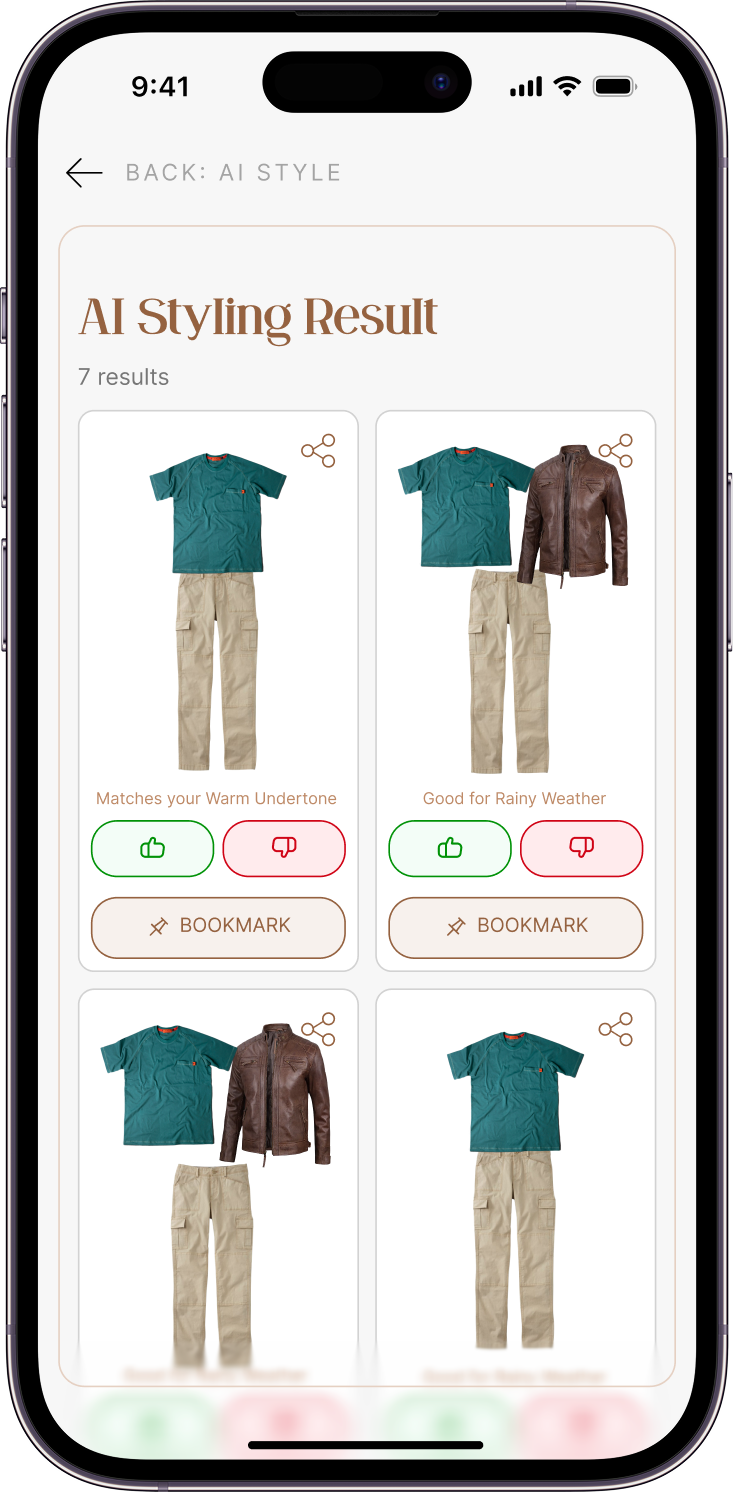
  • Design Impact: We prioritized a "Glass Box" AI approach, where the interface explicitly labels why an outfit was chosen (e.g., "Matches your skin tone," "Rainy Day Appropriate").
"
I'd be okay with [AI suggestions] if it's clear how the photo will be used.

Key Insight 2: The Sustainability Factor

  • Participants admitted to impulse shopping but failing to wear items.
  • Design Impact: We developed a "Scan to Match" feature that pairs new store items with existing wardrobe pieces before purchase.
"
I ask myself, 'Will I wear this at least 5 times?'

Definition & Strategy

Information Architecture Testing

24
Participants
40
Feature cards
Finding
Terms like "Closet History" and "Saved Combos" caused high confusion and misclassification.
Iteration
We renamed these to action-oriented labels like "OOTD Calendar" and "Bookmark Look," which aligned better with user mental models.

Tree Testing

10
Participants
80%
Success rate
After restructuring the sitemap, we validated the new flow using Useberry.
Result
We achieved an 80% success rate for core tasks like "Get Suggestions" and "Add New Item," validating our revised navigation.

Iteration

Visual Design Pivot

Conflict
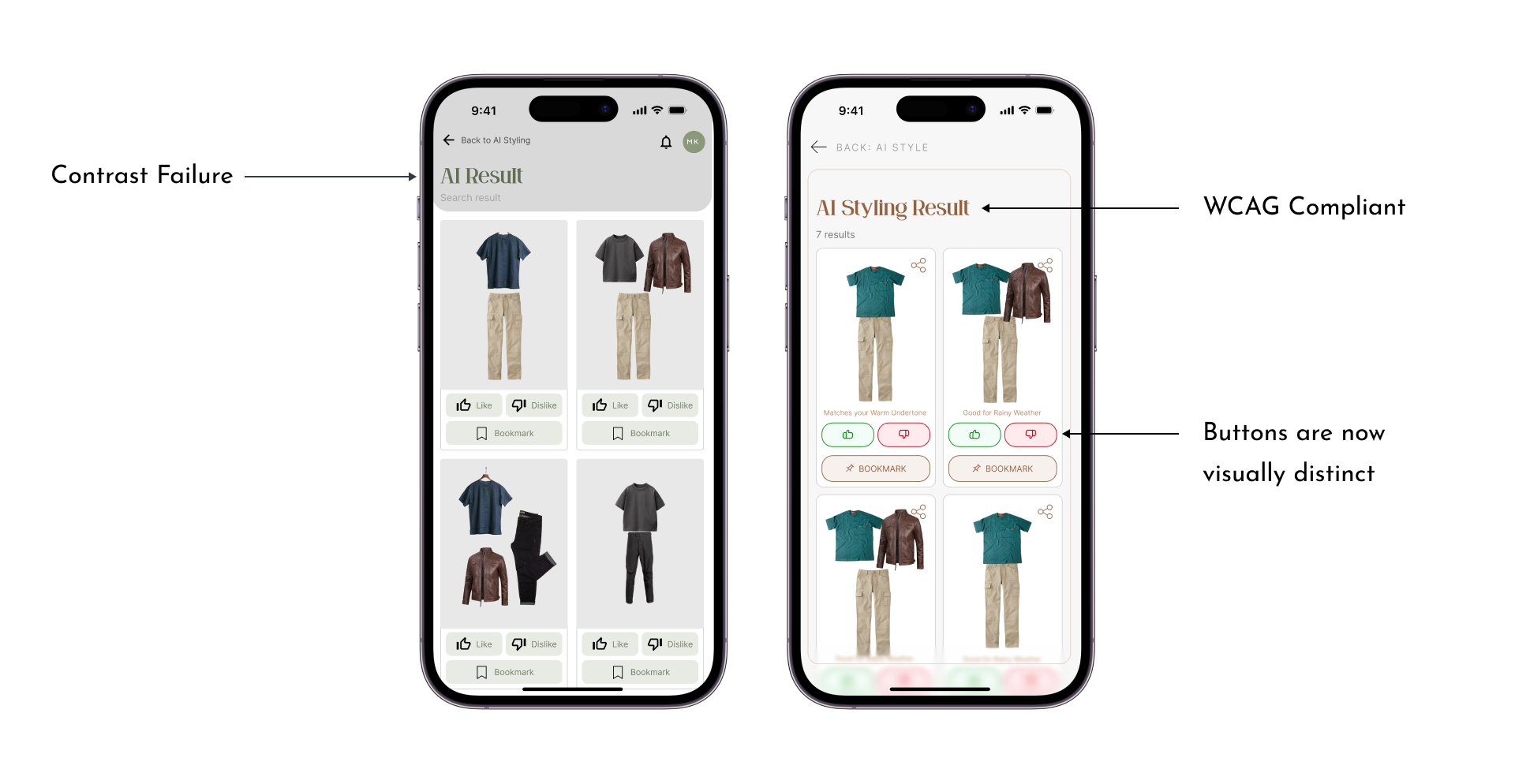
Our initial mood board featured a trendy Dark Olive Green primary color.
Data
Usability testing revealed that users struggled to distinguish interactive buttons from static text due to low contrast.
Fix We pivoted to a Neutral Brown/Earthy palette. This not only passed WCAG accessibility standards for contrast but also better accommodated diverse skin tone visualizations without clashing.
Switching from Olive to Neutral Brown to meet accessibility standards.

Usability Testing

5
Participants
10
Core scenarios
85%
First-Click Accuracy on MVP tasks
We conducted a First-Click test with 5 participants on 10 core scenarios.
Result
80–85% accuracy on core tasks.
Friction Point
Users hesitated between "Style an Item" and "Plan Outfit."Refinement: We added distinct iconography and separated these entry points in the final high-fidelity prototype to reduce cognitive load.

The Final Solution

Smart Closet

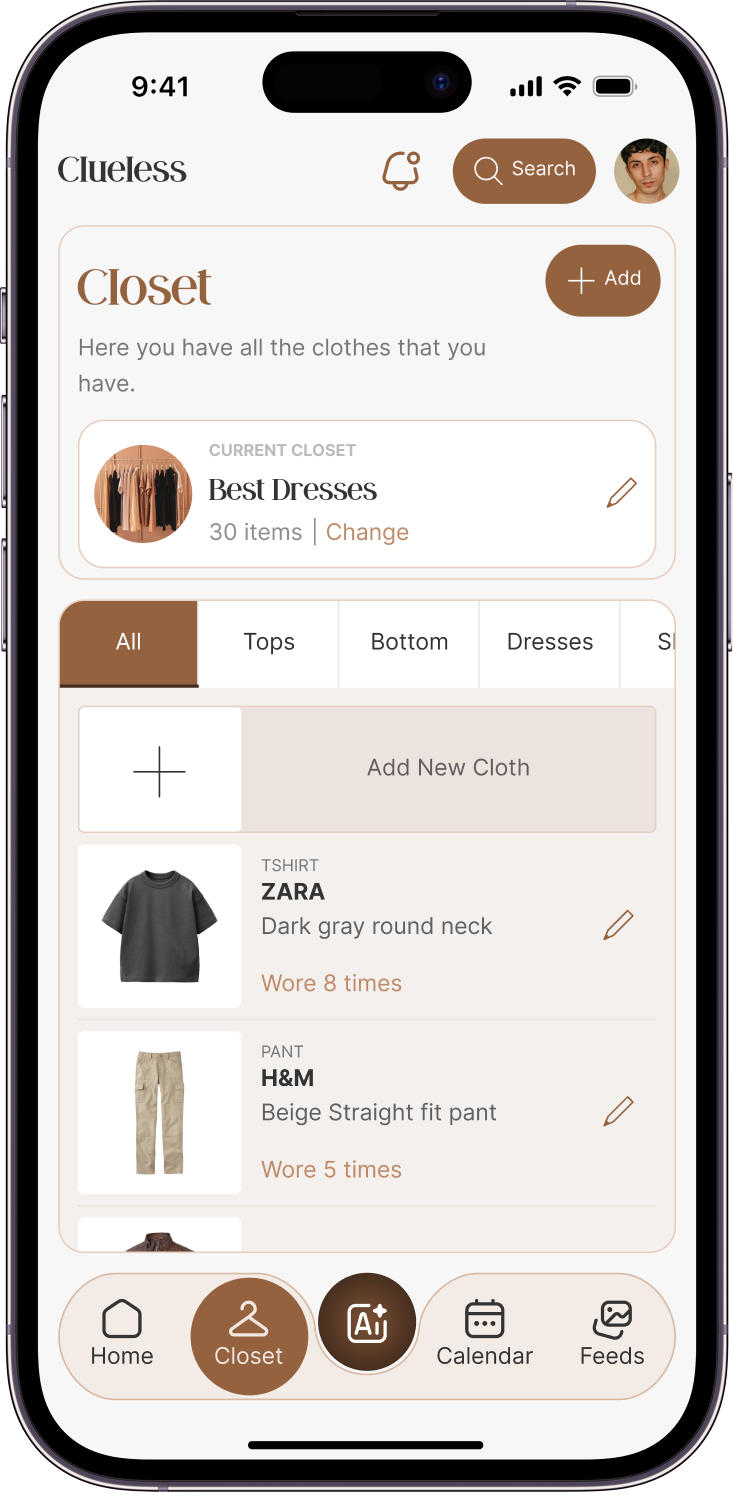
Digital inventory that categorizes items by usage frequency, directly addressing the "unused clothes" pain point.

Context-Aware AI

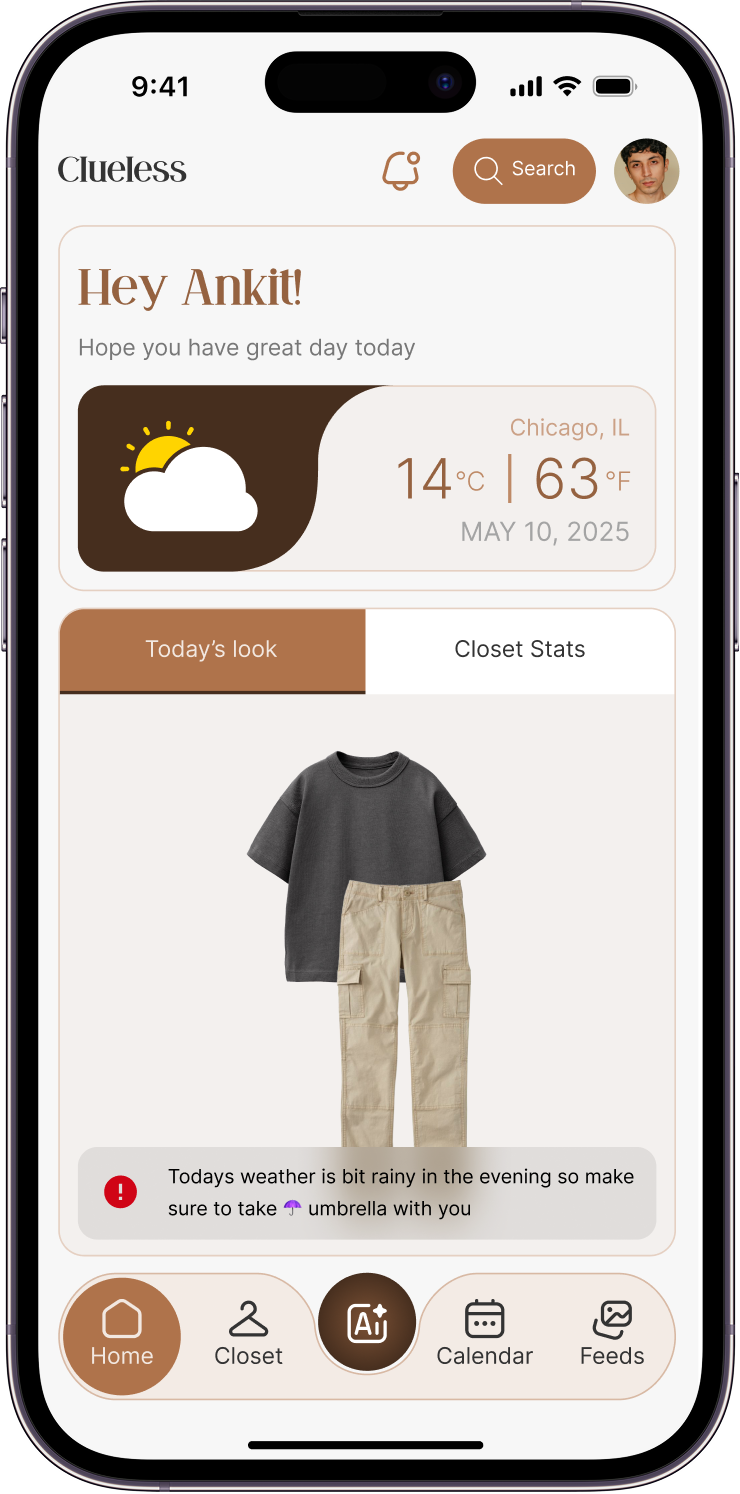
The "Today's Look" feature pulls real-time weather data to suggest practical outfits (e.g., prompting an umbrella on rainy days).

Transparency UI

Every AI suggestion includes a "Why this works" breakdown, directly addressing the trust concerns raised in User Interview.
The Final Prototype

Outcome

Impact

The final prototype successfully balanced automation with user agency. By moving from "prescriptive" (telling users what to wear) to "collaborative" (suggesting options with explanations), we increased user willingness to adopt the technology.

Critical Reflection

Our SWOT analysis highlighted a weakness in front-end development capabilities. To mitigate this, we leaned heavily on high-fidelity Figma prototyping (70+ screens) to simulate complex AI interactions without backend code.

Next Steps

Future iterations would focus on "Social Integration" (getting peer feedback on outfits), a feature requested during interviews to further validate style choices.